
Losing most or all of your teeth changes more than appearance. It affects what you can eat, the clarity of your speech, your confidence in everyday conversations, and over time, the shape of your face. When teeth are missing, the jaw bone beneath them slowly resorbs, causing the hollowed look that so many patients describe as making them look older than they feel.
Full mouth dental implants offer a permanent solution that addresses all of this at once. Anchored into the jaw bone rather than resting on the gums, they replace missing teeth from the root up – and prevent the ongoing bone loss that removable dentures cannot stop.
This guide covers what full mouth dental implants are, your treatment options, costs, the process, and what to consider before a consultation.
Key Takeaways
- Full mouth dental implants replace an entire arch of teeth from the root up — a permanent, fixed solution
- Titanium implant posts fuse with the jaw bone over 3–6 months; this osseointegration is what gives implants their long-term stability
- Cost in Australia typically ranges from $25,000–$45,000+ per arch, depending on the number of implants, restoration type, and whether bone grafting is needed
- The titanium posts can last a lifetime with good care; the prosthetic teeth typically last 15–20+ years
- Medicare does not cover dental implants; private health fund major dental extras may provide a partial rebate — confirm your policy before your consultation
- The right number of implants depends on individual bone volume, density, and anatomy — four implants are not always sufficient
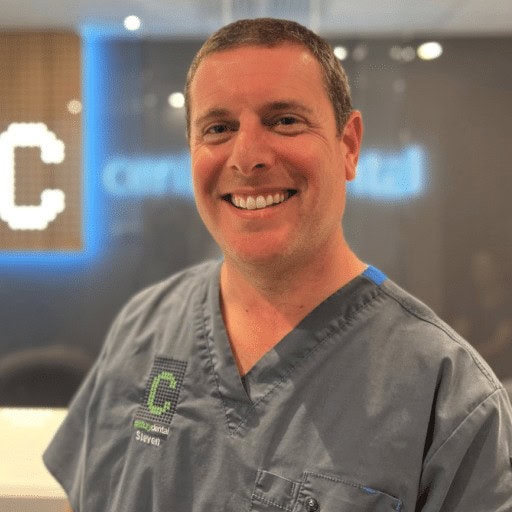
Source: Dr Steven Rostkier BDSc, Balwyn VIC (25+ years clinical experience)
What Are Full Mouth Dental Implants?
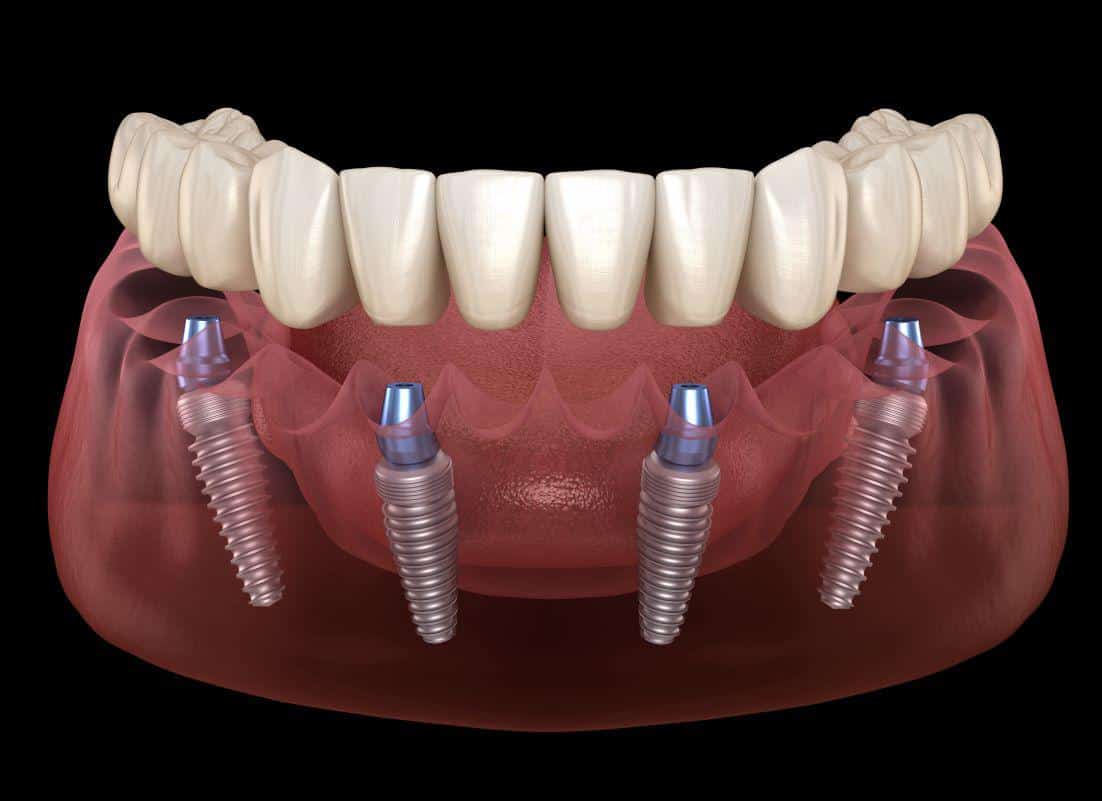
Full mouth dental implants – sometimes called full arch dental implants – replace an entire upper or lower arch of missing teeth using titanium posts as artificial tooth roots. Unlike removable dentures, implants are surgically placed into the jaw bone and become a permanent part of your anatomy.
The bone grows around each post through osseointegration over 3–6 months. This biological fusion is what gives implants their strength and permanence. Once integrated, the posts support a fixed prosthetic arch – a bridge, overdenture, or set of crowns – that does not come out.
For full arch treatment, a coordinated number of implants – typically four to eight per arch – are positioned to support the prosthesis based on bone volume, density, and bite load, not a predetermined template.
How They Compare to Alternatives
| Factor | Full Mouth Implants | Traditional Dentures |
|---|---|---|
| Stability | Fixed – no movement | May slip or shift |
| Bone preservation | Stimulates jaw bone | Bone resorbs over time |
| Eating | Most foods | Restricted diet |
| Longevity | 20+ years to lifetime | 5–7 years |
| Upfront cost | Higher | Lower |
| Long-term cost | Low | Higher (relining, replacements) |
| Surgery required | Yes | No |
The critical difference is what happens beneath the gum line. Implants stimulate the jaw bone the way natural tooth roots do, preventing the bone loss that continues under traditional dentures throughout their life. Over years, this preserves facial structure and bone structure – avoiding the hollowed appearance that develops with long-term denture wear, and the ongoing changes to facial structure that follow tooth loss.
Unlike traditional dentures, implants also restore up to 90% of natural biting force, which means most patients can eat a wide variety of foods without restriction.
Conventional dental bridges require grinding down adjacent teeth to serve as supports – those anchor teeth may develop complications over time. Implants are independent of neighbouring teeth and leave the remaining natural dentition untouched.
See also: dental implants vs dentures for a detailed side-by-side comparison.
Your Full Mouth Implant Options
Fixed Implant-Supported Bridge
Multiple implants – typically six to eight per arch – anchor a non-removable prosthetic arch. The result is the closest to natural teeth in terms of function and feel. The prosthesis does not come out. Best for patients who want a fully fixed result and have adequate bone to support the higher implant count.
Implant-Retained Dentures (Removable)
Four to six implants support a removable prosthetic that clips onto the implants for stability during the day and can be removed for cleaning at night. A good option for patients with moderate bone loss or those where a fully fixed bridge is not the best fit. Significantly more stable than traditional dentures – no slipping, no adhesives.
All-on-4, All-on-6, and Customised Planning
All-on-4 uses exactly four implants – two vertical at the front, two angled at the back – to support a full arch. It works well for some patients but is a standardised template. All-on-6 uses six implants per arch for additional load distribution. Bone density, jaw anatomy, and bite load vary between patients. For some, four implants provide excellent support. For others, five, six, or eight distribute the load more evenly and produce a better long-term result.
“There’s no single protocol that works for everyone. I design each case around the patient in front of me – the number of implants, their positions, and the type of restoration all depend on what the imaging actually shows about that person’s jaw,” says Dr Rostkier.
A customised treatment plan uses 3D CBCT imaging to determine the right number and placement for that patient’s anatomy rather than fitting a template to the jaw. More on All-on-4 vs customised planning →
The Treatment Timeline
Full mouth implant treatment typically takes 3–12 months from initial consultation to final restoration:
- Consultation and 3D imaging – Detailed assessment of jaw bone volume, density, and anatomy; medical history and medication review
- Treatment planning – Digital scan, implant positions mapped precisely, final restoration design agreed
- Implant placement surgery – Performed under local anaesthetic with sedation options available; temporary prosthesis fitted shortly after
- Osseointegration (3–6 months) – Implants fuse with the jaw bone; temporary teeth worn throughout
- Final restoration – Permanent replacement teeth – bridge, overdenture, or crown set – fitted once osseointegration is confirmed
Patients are never left without teeth during the process. If bone grafting is needed beforehand, add 3–6 months before placement can proceed.
Cost
Full mouth dental implants in Melbourne typically cost $25,000–$45,000+ per arch. The main cost variables:
- Number of implants – a 4-implant plan costs less than a 6- or 8-implant plan
- Restoration type – fully fixed bridge vs implant-retained denture
- Bone grafting – adds $2,000–$3,500 and extends the treatment timeline
- Case complexity – extractions and other preparatory treatment
Medicare does not cover dental implants. Private health fund major dental extras cover may provide a partial rebate on some components – confirm what your policy covers before your consultation. Flexible payment plans are available at most implant practices to help spread the investment.
A detailed, itemised cost estimate should be provided before any treatment begins. Full cost breakdown →
Longevity
With proper care, the titanium implant posts can last a lifetime. Clinical studies show success rates of 90–95% at ten years across patient populations, and many implants remain stable for 20–30 years or more. The prosthetic teeth typically last 15–20+ years before replacement may be needed.
Good oral hygiene – daily brushing and interdental cleaning – professional hygiene appointments every six months, and periodic bone level monitoring are what protect that investment over the long term. Maintaining good oral health supports implant success just as it does natural teeth. Full guide to implant longevity →
Are You a Candidate?
Most adults are candidates for full mouth dental implants – there is no upper age limit. The key requirements at initial assessment:
- Bone volume – adequate jaw bone to support the posts, or bone grafting to build it up first
- Gum health – active gum disease needs treatment before implant planning begins
- General health – conditions including uncontrolled diabetes, bisphosphonate medications, and heavy smoking all require specific discussion; none automatically rule out treatment, but all affect planning
Candidacy cannot be determined from a website. A 3D imaging assessment gives the definitive picture based on actual bone anatomy and health history.
Choosing an Implant Dentist in Melbourne
The success of dental implants depends as much on the skill and experience of the implant dentist as on the materials used. When evaluating dental implant solutions in Melbourne, look for a practice that:
- Provides 3D CBCT imaging as standard for all implant treatment planning
- Offers customised treatment plans based on your anatomy – not a one-size template
- Works with experienced implant specialists for the surgical stage
- Has clear, itemised cost estimates before any treatment begins
- Offers long-term maintenance and follow-up as part of the service
The quality of ongoing dental care after the final restoration is often overlooked – it is what determines whether implants last decades or fall short of their potential.
At Our Balwyn Melbourne Clinic
Dr Steven Rostkier is an experienced implant dentist with 25+ years in restorative and aesthetic dentistry, with a focus on implant-supported restorations and complex full-arch rehabilitation. As a trusted Balwyn dental practice, we coordinate each case from initial planning through to the final restoration and ongoing maintenance.
For the surgical stage, Dr Rostkier works with trusted specialist periodontists – experienced implant surgeons focused on precise placement. He coordinates all treatment planning and fits every final restoration himself, ensuring continuity of care throughout the process.
The practice uses advanced dental technology as standard: 3D CBCT imaging, intraoral digital scanners, and CAD-CAM systems for precision restoration fabrication. HICAPS is available for on-the-spot health fund claims. Flexible payment plans can be discussed at your dental implant consultation. We pioneered one of Victoria’s first dedicated hygiene departments – nearly 30 years running – which supports ongoing implant maintenance and long-term oral health long after the final restoration is fitted.
Call (03) 9831 3272 or book online to arrange an appointment. or visit 2a/379-381 Whitehorse Rd, Balwyn VIC 3103. We see patients from Balwyn, Balwyn North, Deepdene, Canterbury, Camberwell, Box Hill, Surrey Hills, Hawthorn, Mont Albert, Kew, and Doncaster.
This content is for general information only and does not constitute clinical advice. Individual treatment costs and outcomes depend on assessment findings specific to each patient.