

Replacing a full arch of missing or failing teeth is one of the most significant decisions you can make about your oral health. You want the outcome to last decades, not just a few years. And you want to make that decision based on what actually suits your jaw – not on a system designed to fit the widest possible range of patients.
All-on-4 dental implants have helped a lot of people across Melbourne and around the world. For some patients, they are genuinely a good option. But they are not the right option for everyone, and the difference often comes down to anatomy that only a 3D imaging assessment can reveal.
This post covers what All-on-4 is, what it does well, where it has limitations, and why a customised full-arch plan is sometimes the better clinical choice.
Key Takeaways
- All-on-4 uses four dental implants to support a full arch of replacement teeth – two vertical at the front, two angled at the back
- Typical Melbourne cost: $23,000–$30,000 per arch for All-on-4; customised plans with more implants range from $25,000–$45,000+ depending on complexity
- Four implants suit many patients well – others benefit from 5–8 implants for better load distribution
- The angled posterior implants can reduce but do not always eliminate the need for bone grafting
- A temporary prosthesis is usually fitted within days of surgery, providing functional teeth throughout the healing phase
- Only a 3D imaging assessment can determine which full-arch approach suits your jaw
What Is All-on-4?
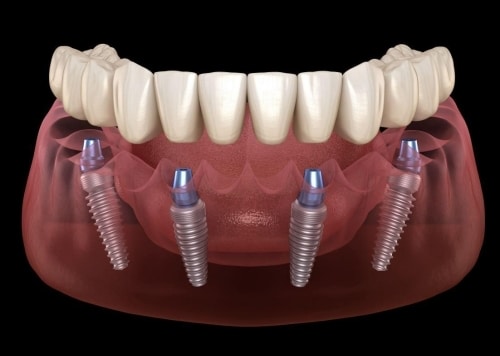
All-on-4 is a full arch rehabilitation system. Four titanium implants support a complete set of fixed artificial teeth – for the upper arch, lower jaw, or both.
Two vertical implants anchor at the front of the jaw. Two posterior implants are angled at approximately 45 degrees toward the back. That angled position allows the surgeon to engage denser bone further forward and, in many cases, avoid the sinus cavity in the upper jaw. This is why All-on-4 can reduce – though not always eliminate – the need for bone grafting before surgery.
A temporary prosthesis is usually fitted within days of placement. The permanent restoration – typically zirconia or reinforced acrylic – is fitted at around six months, once osseointegration is confirmed complete.
The Advantages of All-on-4
All-on-4 earned its place in full arch rehabilitation for good reasons:
- Fixed, not removable. The prosthesis is anchored to four implants and does not come out. No adhesive, no overnight removal. For patients who have managed with traditional dentures, the difference is significant.
- Faster timeline. Four implants rather than one per tooth reduces surgical time and the overall treatment period.
- Works with moderate bone loss. The angled approach engages bone where some deterioration has occurred, making All-on-4 viable for patients who might otherwise need substantial grafting.
- More accessible cost. With fewer implants than a fully customised plan, All-on-4 typically sits at $23,000–$30,000 per arch in Melbourne – toward the lower end of full-arch pricing.
For the right patient, these are genuine advantages. The question is whether All-on-4 is the right fit for your jaw.
Why All-on-4 Isn’t Always the Best Choice
All-on-4 is a protocol – developed to work for a broad range of patients in a standardised way. That is also its limitation.
Every jaw is different. Bone width, height, density, and the available angles for implant placement vary considerably between patients. In some jaws, the standard four-implant pattern fits naturally. In others, it does not.
More implants distribute bite load across more contact points. Patients with excellent bone quality across a full arch may find that four implants leave support capacity on the table – a fifth or sixth implant would have been the clinically correct answer. For patients who grind their teeth or have a naturally heavy bite, concentrating that force on just four implants can create excessive stress on each one over a 20-plus year period.
The angled posterior approach reduces the need for bone grafting but does not eliminate it in cases of severe bone loss. Asymmetrical jaw geometry or unusual bone angles can also make the standard four-implant layout less appropriate.
“All-on-4 works well for the right patient. But I’ve seen cases where a fifth or sixth implant would have made the difference between a good outcome and a great one. When I’m looking at a patient’s 3D scan, I’m asking what their jaw actually needs – not which system ticks the most boxes on a protocol checklist,” says Dr Rostkier.
This preference for anatomy-first planning over standardised templates is why Dr Rostkier designs full-arch implant cases from the imaging up. A 3D CBCT scan maps bone volume, density, and position across the entire arch. The number and placement of implants is then chosen for that specific jaw – which may be four, or may be five, six, or eight. Full details on our full-arch approach →
Cost: All-on-4 vs Customised Plans
All-on-4 treatment in Melbourne typically costs $23,000–$30,000 per arch. Customised full-arch plans using 5–8 implants typically range from $25,000–$45,000+ per arch, depending on the number of implants, bone grafting requirements, and restoration complexity.
The cost difference is real, but worth contextualising. A well-planned, well-placed full arch restoration can last 20 or more years. The upfront difference between a 4-implant and a 6-implant plan may look significant today. The cost of a revision or complication a decade from now will look larger.
Health fund rebates apply to some components of implant treatment. Payment plans are available at most implant practices. Full breakdown of implant costs in Melbourne →
Recovery Overview
Most patients find All-on-4 surgery more manageable than expected under local anaesthetic. A soft diet for the first one to two weeks is standard, with swelling and bruising settling within seven to ten days. The temporary prosthesis means functional teeth throughout the healing phase. The permanent restoration is fitted at approximately six months, once osseointegration is confirmed.
Is All-on-4 Right for You?
All-on-4 may suit you well if:
- You have moderate bone loss but adequate bone in the right locations for the standard four-implant placement
- You maintain good oral hygiene and are a non-smoker or have significantly reduced smoking
- You want functional replacement teeth during the healing phase
- Your jaw anatomy aligns with the standard 4-implant placement pattern
A customised plan with more implants may serve you better if:
- 3D imaging shows bone patterns that do not suit a standard four-implant layout
- You grind your teeth and would benefit from wider load distribution across more implants
- Your jaw anatomy or bite calls for a different number or position of implants
The honest answer to “is All-on-4 right for me?” cannot be given from an article. It requires looking at your actual jaw with 3D imaging – bone density, bone volume, available angles. See also: how long dental implants last →
At Our Balwyn Practice
For the surgical stage, Dr Rostkier works with trusted specialist periodontists – experienced implant surgeons focused on precise placement. Dr Rostkier coordinates the planning and fits every final restoration himself, drawing on 25+ years of restorative and aesthetic dentistry experience.
HICAPS is available for on-the-spot health fund claims. Payment plans can be discussed at consultation.
To book, call (03) 9831 3272 or visit 2a/379-381 Whitehorse Rd, Balwyn VIC 3103. We see patients from Balwyn, Balwyn North, Deepdene, Canterbury, Camberwell, Box Hill, Surrey Hills, Hawthorn, Kew, Mont Albert, and Doncaster.
Frequently Asked Questions
How long do All-on-4 implants last?
The titanium posts can last a lifetime with good care – they integrate with the jaw bone and typically remain stable for decades. The prosthesis generally lasts 10–15 years before it may need updating due to normal wear. Good oral hygiene, professional cleaning every six months, and avoiding habits that place excessive force on the teeth all contribute to longevity.
Are All-on-4 implants painful?
The surgical procedure is performed under local anaesthetic. Most patients report less discomfort than expected. Swelling and bruising settles within seven to ten days. Sedation dentistry is available for patients with dental anxiety – discuss this at the initial consultation.
Can I eat normally with All-on-4 implants?
Soft foods for the first one to two weeks after surgery, progressing as healing allows. Once osseointegration is complete and the permanent restoration is fitted at six months, most patients can eat a full range of foods normally. Very hard foods are best avoided to protect the prosthetic components over the long term.
Who is not a good candidate for All-on-4?
Heavy, long-term smokers face significantly increased implant failure risk. Patients with severe, widespread bone loss may not have adequate bone in the required locations even with the angled approach. Uncontrolled diabetes and certain medications can affect implant healing. Patients who grind heavily may find the load concentration on four implants creates longer-term risk. These factors are assessed at consultation using 3D imaging.
Do I need bone grafting for All-on-4?
Not necessarily. The angled posterior implants are designed to engage bone in areas where some loss has occurred, which often reduces the need for grafting. In moderate bone loss cases, many patients can proceed without it. Severe bone loss in specific regions may still require grafting. The 3D imaging assessment at consultation determines whether grafting is needed in your case.
What is the difference between All-on-4 and a customised full-arch plan?
All-on-4 uses exactly four implants placed in a standardised pattern. A customised plan starts from the patient’s individual jaw anatomy – bone volume, density, and available angles – and determines the right number and placement from there. Some patients are well served by four implants. Others benefit from five, six, or eight, depending on what the imaging shows about that specific jaw. Visit this page to learn more about dental implants in Balwyn.
This content is for general information only and does not constitute clinical advice. Individual treatment costs and outcomes depend on assessment findings specific to each patient.