
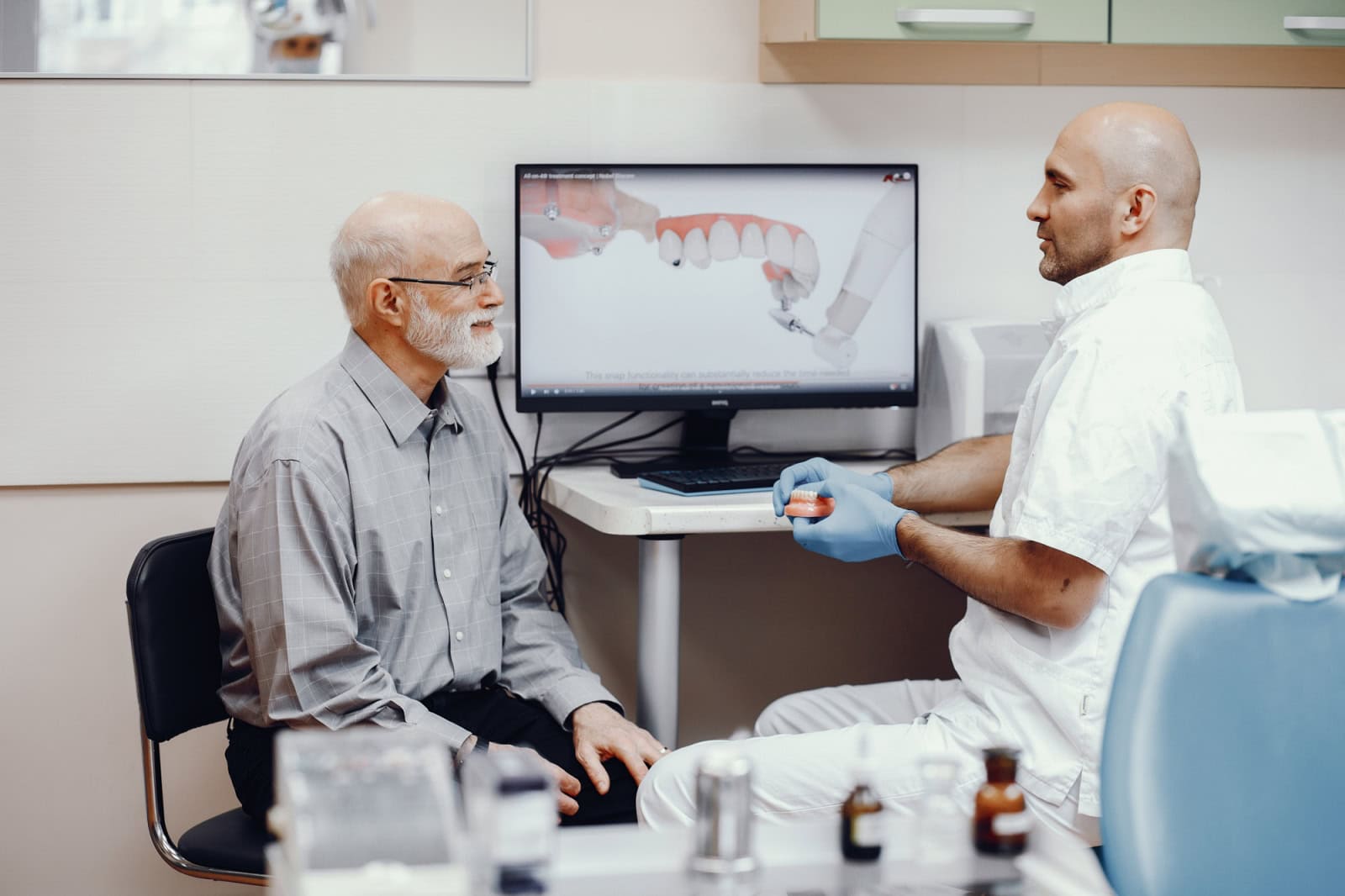
When you lose most or all of the teeth in an arch, the conversation quickly turns to full-arch implant treatment. For many patients, the first dental implants treatment option they encounter is All-on-4 – it is heavily marketed, well-known, and widely available across Melbourne. But All-on-4 is not the only way to rebuild a full arch, and it is not automatically the best fit for every jaw.
All-on-4 is a genuine, well-validated system. It works well for certain patient profiles and delivers predictable results when the anatomy aligns with its design. Where it has limits is the same place any standardised template has limits – it was engineered for the general case, not necessarily for yours.
This article compares All-on-4 in Melbourne with customised full-arch implant planning – how they differ structurally, when each one is the better choice, and what questions are worth asking your dentist before you decide.
Key Takeaways
- All-on-4 uses four titanium implants to support a fixed full-arch prosthesis – typically $23,000-$30,000 per arch in Australia
- Customised full-arch plans use 5-8 strategically positioned implants designed around the patient’s specific bone structure – typically $25,000-$45,000+ per arch
- All-on-4 is well-suited to patients with moderate bone loss and uncomplicated jaw anatomy
- Patients with irregular bone density, bruxism, or asymmetrical jaw structure may achieve better long-term results with a customised plan
- The number and placement of implants in a customised plan is determined by 3D imaging, not a standard formula
- Neither approach involves the restoring dentist placing the implants – surgical placement is performed by a specialist periodontist
What Is All-on-4?
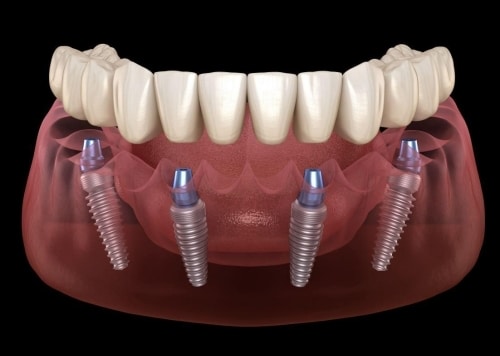
All-on-4 is a branded full-arch implant protocol developed by Nobel Biocare. Four titanium implants are placed into the jawbone per arch – two vertical posts at the front and two angled at roughly 45 degrees toward the back. The angled rear implants anchor into areas where bone tends to be denser, which often eliminates the need for bone grafting.
A fixed prosthesis – a full set of replacement teeth – is attached to these four implants. In many cases, a temporary prosthesis can be fitted on the same day as surgery, giving patients functional teeth immediately while the implants integrate with the bone over the following months.
It is a well-established system used successfully around the world for over two decades. The standardised approach keeps surgical time shorter and costs lower than plans requiring more implants. For patients whose jaw anatomy fits the template, All-on-4 delivers strong, predictable results. For a detailed look at the procedure itself, see our guide to All-on-4 in Melbourne.
What Is a Customised Full-Arch Implant Plan?
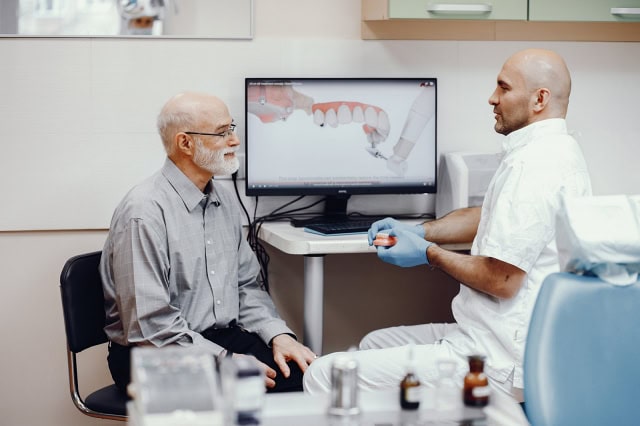
A customised full-arch implant plan is not a branded product. It is clinical planning that starts with your anatomy rather than a fixed formula. The treating dentist uses 3D CBCT imaging to map bone volume, density, and geometry across the entire arch, then determines how many implants are needed and exactly where each one should sit.
The result might be five implants. It might be six, seven, or eight. The number follows what the bone can support and where support is needed most – it is not predetermined by a protocol.
Each implant is positioned to take advantage of where bone quality is strongest. Abutments and the final prosthesis are then designed around this anatomy-driven foundation. This adds time and cost to the planning phase, but it means the dental implant treatment is built around the patient rather than asking the patient to fit the system.
This is not a niche or experimental approach. It is what thorough full arch implant planning looks like when the clinician begins with a 3D picture of the patient’s jaw and works forward from there.
How They Compare
| Feature | All-on-4 | Customised Full-Arch Plan |
|---|---|---|
| Implant count | 4 per arch (fixed) | 5-8 per arch (anatomy-dependent) |
| Candidacy | Moderate bone loss, standard anatomy | Broader – plan adapts to complex anatomy |
| Cost range (per arch, AU) | $23,000-$30,000 | $25,000-$45,000+ |
| Load distribution | 4 fixed points | Spread across 5-8 strategic positions |
| Design flexibility | Standardised template | Fully customised to jaw geometry |
Cost
The price difference is real and should be part of any informed decision. All-on-4 typically costs $23,000-$30,000 per arch in Australia, while a customised plan with 5-8 implants generally falls between $25,000-$45,000+ per arch depending on case complexity. That gap can narrow over time if a standardised plan requires revision because it did not suit an individual’s bone structure or bite pattern – but the upfront difference is significant. For a broader look at pricing, see full arch implant costs in Melbourne.
Candidacy and Bone Structure
All-on-4 was specifically designed to work around moderate bone loss. The angled rear implants anchor into bone that is typically still dense even after years of tooth loss, which means many patients avoid bone grafting procedures entirely. This is a genuine strength of the system.
Where it becomes less predictable is in patients with very uneven bone density across the arch, significant asymmetry, or localised deficit areas that fall outside the standard placement zones. A customised plan allows the clinician to position implants where the bone actually supports them, rather than relying on a template that may not match the patient’s structure.
It is also worth noting that significant tooth loss – particularly when teeth have been missing for several years – can lead to bone resorption in the jaw. The extent of that resorption directly affects which approach is appropriate, and is one of the key things 3D imaging reveals before treatment planning begins.
Load Distribution
Four implants concentrate bite force on four points. For patients with a moderate bite and uncomplicated anatomy, this is perfectly adequate. But for heavy biters or patients with bruxism, four concentrated stress points increase the long-term risk of mechanical failure or prosthesis fracture.
A plan with six or eight well-positioned implants distributes that same force more evenly across the arch. Each implant carries less individual stress, which reduces strain on both the implant and the surrounding bone over time.
Design Flexibility
All-on-4 follows a spatial template that suits average jaw anatomy well. When bone height varies significantly across the arch, when the jaw is asymmetrical, or when bite patterns fall outside the standard profile, that template becomes a constraint. Customised planning adapts to these variations because implant positions are determined by 3D imaging of the patient’s actual bone – not by a predetermined formula.
When All-on-4 Is the Right Choice
All-on-4 is not a compromise – for the right patient, it is an excellent solution. The system is backed by decades of published research and thousands of successful outcomes globally.
The patients who benefit most typically share a common profile: moderate and relatively uniform bone loss, uncomplicated jaw anatomy without significant asymmetry, no bruxism or heavy grinding habits, good general health, and consistent home care. Good oral hygiene habits are particularly important for long-term implant success – patients who maintain regular dental check-ups tend to see the strongest outcomes. Non-smokers tend to see the strongest long-term results.
All-on-4 also offers practical advantages that matter to patients. The surgical phase is faster than placing six or eight implants. Temporary teeth are often fitted the same day. And the lower implant count keeps costs down without sacrificing structural integrity – provided the jaw anatomy fits the four-point design.
If your bone structure aligns with the All-on-4 template, choosing a more complex plan does not make treatment better. It just makes it more expensive.
When a Customised Plan May Be the Better Fit
Certain patient profiles consistently benefit from anatomy-driven planning over a standardised protocol. Heavy grinders place ongoing mechanical stress on the prosthesis that distributes more safely across six or eight implant points than across four. Patients with asymmetrical jaw structure – where bone density or height differs significantly between the left and right sides – may find that a four-point system leaves one area underpowered.
Uneven bone density is another common indicator. If 3D imaging reveals strong bone in some zones and poor bone in others, a customised plan can position implants precisely where support is adequate rather than forcing placement into a fixed pattern.
For patients who have been wearing removable dentures for years, bone resorption is often more pronounced and less predictable in its distribution across the arch. This makes anatomy-first planning – rather than a standardised four-point approach – particularly relevant for this group.
At Dr Steven Rostkier’s Balwyn practice, the preference is to assess each patient’s bone structure and jaw mechanics through 3D imaging first and determine implant count and placement from that assessment – whether that results in four, five, six, or eight implants. This anatomy-first approach adds planning complexity but can improve long-term stability for patients whose jaw does not fit the standard All-on-4 template.
Patients with a history of implant complications or previous dental work that has altered bone structure also warrant assessment for customised planning. Your dentist will review the imaging, discuss the trade-offs, and recommend whichever approach the anatomy supports.
The Role of the Specialist Periodontist
For both All-on-4 and customised full-arch treatment, the surgical placement of implants is performed by a specialist periodontist – not the restoring dentist. This two-professional model means each stage is handled by the clinician most qualified for that specific task.
The restoring dentist manages treatment planning: 3D imaging, case design, implant positioning decisions, and the design and fitting of the final prosthesis – the teeth that are visible and functional. The periodontist performs the surgical procedure itself, placing titanium implants into the jawbone under controlled conditions.
This structure ensures specialist surgical skills for the placement stage and dedicated prosthetic expertise for the restoration. It also means the restoring dentist maintains continuity from the first imaging appointment through to the finished result – they are involved at every stage, not just the end.
Frequently Asked Questions
What is the difference between All-on-4 and All-on-6?
All-on-6 uses six implants per arch – the same front-and-back configuration as All-on-4 plus two additional vertical posts for increased mid-arch support. It suits patients with denser bone or heavier bite loads who need more anchorage than four points provide. Cost typically falls between All-on-4 and a fully customised plan. Neither is automatically superior – implant count should follow anatomy, not a product name.
Is All-on-4 a permanent solution?
The titanium implant posts are designed to be permanent, with published lifespans of 10-20+ years when properly maintained. The prosthesis – the visible teeth attached to those posts – typically requires replacement or refurbishment every 10-15 years due to normal wear. “Permanent” is accurate for the implants themselves, but the prosthesis will need attention over time.
Can All-on-4 fail?
Yes, though failure rates are relatively low. Published research generally reports around 5-10% implant failure over a 10-year period. The most common risk factors are smoking, poor bone density at placement sites, uncontrolled diabetes, and excessive bite force. A customised plan with more implants can reduce failure risk by distributing load more evenly, but no approach eliminates it entirely.
Do I need bone grafting for All-on-4?
Not always. The angled rear implants are specifically designed to anchor where bone is typically adequate, even in jaws that have experienced moderate loss. This often avoids bone grafting where other approaches would require it. However, severe bone loss or specific deficit areas may still need grafting regardless of which approach is chosen. 3D imaging determines this before treatment begins.
Can I eat normally after full-arch implant treatment?
Yes, once healing is complete. Expect a soft-food diet for the first four to six weeks while the implants integrate with the bone – a process called osseointegration. Full function is typically restored at three to six months when the final prosthesis is fitted. Both All-on-4 and customised plans allow normal eating once fully healed. Full-arch dental implants are designed to function like natural teeth once osseointegration is complete.
How do I know which approach is right for me?
An initial consultation that includes 3D CBCT imaging is the only reliable way to determine this. The imaging shows bone volume, density, and geometry across the full arch – the information a clinician needs to assess whether the All-on-4 template fits your jaw or whether a customised plan is warranted. No amount of online research can replace this assessment for your specific case.
What is the recovery like after full-arch implant surgery?
Recovery is managed by the specialist periodontist who performs the surgical placement. Most patients experience 24-48 hours on liquid or very soft foods, mild to moderate discomfort for 7-14 days managed with standard pain relief, and temporary teeth in place throughout the healing period. The final restoration is fitted at the three-to-six-month mark once osseointegration is confirmed.
What happens to the jaw bone when teeth are missing?
When teeth are lost, the jawbone in that area no longer receives stimulation from biting forces and begins to resorb – gradually reducing in volume and density. This is one reason tooth replacement with dental implants is preferable to leaving a gap or relying on removable dentures long-term: implants transfer biting force directly into the bone, helping to preserve jaw bone structure and maintain facial features over time.
At Our Balwyn Practice
Dr Steven Rostkier has over 25 years of clinical experience in restorative and implant dentistry. Full-arch implant consultations at the practice start with 3D imaging and a thorough assessment of bone structure, bite mechanics, and long-term goals – before any treatment path is recommended.
Surgical implant placement is performed by trusted specialist periodontists. Dr Rostkier handles the treatment planning, case design, and final prosthesis – ensuring continuity from your first consultation through to the finished result.
Your initial consultation includes a full oral examination, 3D imaging where indicated, and a straightforward discussion of whether All-on-4 or a customised dental implants plan suits your situation. You receive a written cost breakdown before any treatment begins.
Payment and health fund information:
- HICAPS for on-the-spot health fund claims
- Payment plans available for full-arch treatment
- All major credit cards, cash, and cheques accepted
We see patients from Balwyn, Balwyn North, Canterbury, Camberwell, Deepdene, Box Hill, Surrey Hills, Hawthorn, and Kew.
This content is for general information only and does not constitute clinical advice. Individual treatment costs and outcomes depend on assessment findings specific to each patient.